Gameplay Style
Micro Explore Puzzle
Comparable Gameplay: Betrayal at Krondor Puzzle Encounter
Distinguishing Features: Micro scale lens
Style Highlights
Players Supported: Typically, 2+ Co-Op.
Estimated Play Length: Optimized for brevity, 1-5 minutes for experienced players.
Force Size: Small, 2-6
Unit Action Complexity: Variable
Lethality: Low to mid. Often a resource drain or loot risk/reward gamble.
Lens & Subject: More focused more on objects interacted with, and what characters do & do not notice about them.
Fun & Identity Focuses
World Dangers. Like overworld maps’ random encounters, explore puzzles can be region themed, used to show the dangers of crossing swamps, desserts, fast water, and like.
Challenge Variety. Explore puzzles add variety to challenges players can overcome.
Incentive for Skill Diversity. Explore puzzles create incentives to take character not optimized for tactical combat. This can shift the challenge and feel of tactical battles, and introduce fun squad composition dynamics.
Character Authoring. Micro Puzzles help support character identity as expressed through the awareness the character brings to squad, and the explore techniques added.
Additional Flavors
Progression Gates. Explore puzzles pair well with progression systems, with exploration a chance to gain materials, loot, or discoveries needed for progressing. This allows for scenario design with gates related to obtaining characters with appropriate explore skillsets.
Demo Scenario Setup
Goal: Get past the door.
Loss: Party KO’d or retreats from entrance.
Turns: Unlimited.
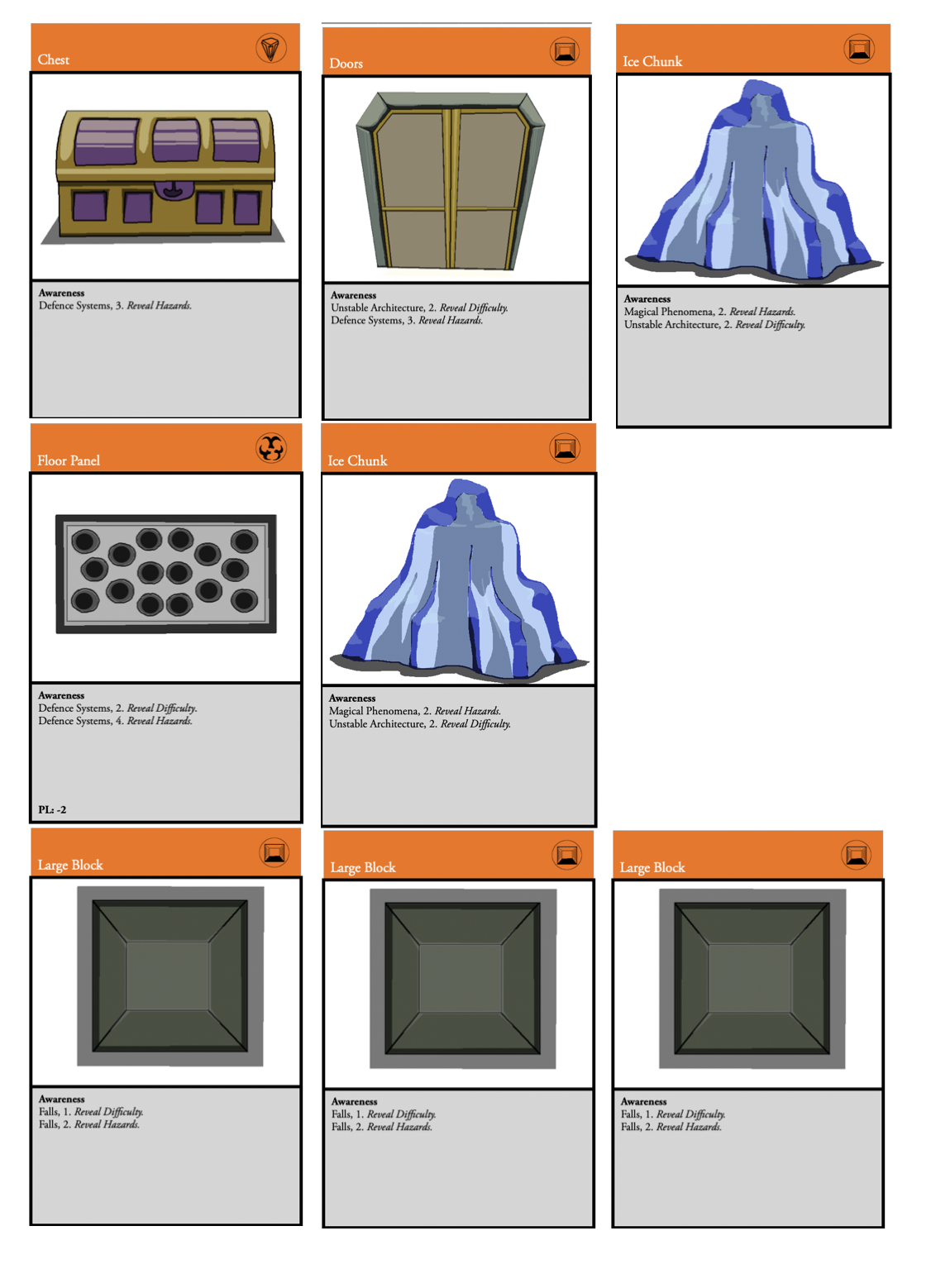
Player Units. Uses the micro-battle’s Gobold, Dverg, and Necrotic unit cards, as well as these character cards’ ‘explore techniques’ backsides.
Opposition Units: Large Block, Ice Chunk, Floor Panel, Chest, & Door interactable cards.
Explore Puzzle Special Rules
Adventuring & Exploration. Explore puzzles will use Radiant’s core explore rules. See the free, prototype, Adventure Screen for rules on resolving explore interactions.
Targeting Explorables:
- A unit must be directly adjacent to an explorable to interact with it.
- Units who stand in same tile both suffer any hazards.
- Moving through an explorable requires a manuver outcome success.
- A unit must be on same or +/-1 height difference to interact with an explorable.
Alert. On an alert consequence, fight the micro-tactics demo using your characters, then continue. Injuries carry over.
Try Again? So long as you’re not KO’d, you can make as many attempts as you’re willing to risk.
Playtest Feedback
Q. How similar is the demo’s gameplay to comparable games?
Q. What adjustments would make the gameplay better?
Key Parameters
(lower/higher/about right)
Lethality: How quickly units are KO’d.
Action Complexity: How many choices per unit, how long force play decision making takes.
Force Size: Total number of units.
Play Length: How long should it take to play out a tactical battle. (‘Too long, too short.’)
Challenge: How difficult the tactical battle should feel. (‘Too hard, too easy’.)
Unit Expendability: How concerned with losing units should players be. (‘Feels too punishing to lose, feels too expendable.’)
Map Design: How fitting map design is for gameplay mode.
Objective vs KO Focus: Which should genre’s gameplay emphasize more?


Share?
Tips Appreciated
Disclaimer: The product names and trademarks of other tactics games and RPG systems are mentioned on this website for sole purposes of comparison, critique, review or education. Radiant Tactics does not claim compatibility with any mentioned system, nor are any claims of ownership advanced.
 RADIANT TACTICS