
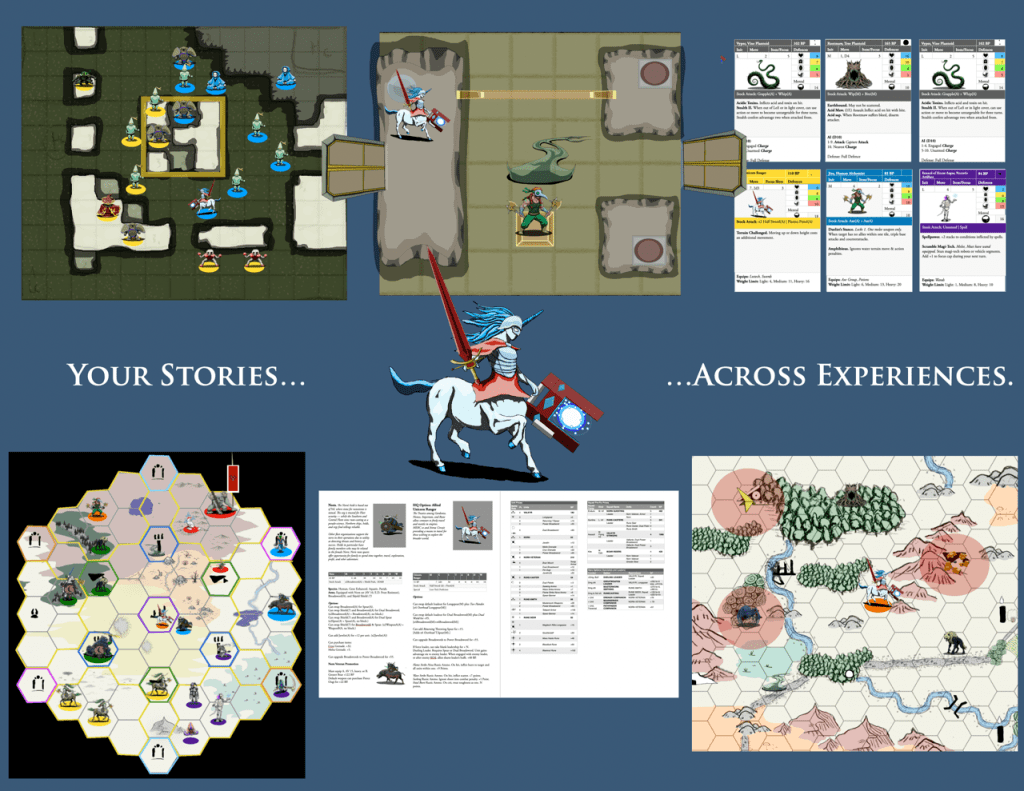
ISOMORPHIC LEGENDS
A series about the strange problems that emerge when designing game systems where characters can continue stories across RPGs, CCGs, wargames, and more.
#1. The Overarching Problem. How do you tell one story across different kinds of games?
Imagine a campaign where Act I is an RPG adventure.The characters make choices, defeat enemies, and change the world.
Then the story moves into Act II. But now, the players are playing a CCG. The choices and consequences from the RPG affect what happens in the card game.
Then Act III becomes a wargame. The characters and factions from the earlier acts are still there, but now the players are commanding armies.
How do you make one story continue across all three? That’s the problem we’re trying to solve with Radiant Tactics.
Design Space
Today, you could stitch together different games to create something like this. But you would be taking on a lot of problems that each game system normally gets to ignore. You’d run into walls, hard sub-problems that look like:
- One story, multiple systems.First, everyone would need to learn multiple games.
If your story moves from an RPG to a CCG to a wargame, you’re asking players to learn three rule sets, acquire three sets of materials (expensive!), and become comfortable playing three very different games.
That isn’t impossible, but does create significant barriers to continuing the story. - One world, different ways of experiencing it. The setting has to hold together, too.
Magic: The Gathering, D&D, and 40K each have their own distinct worlds, and none of them were built to hand off to each other. If you want one story to move between formats, you need a setting that can support all of them.
The same world has to work as the backdrop for a card game, a role-playing campaign, and a tabletop battle, without feeling like it’s straining to fit whichever format it’s currently in. That means worldbuilding a coherent foundation for different scales and styles of play. - One character, multiple formats. Then there’s the problem of character continuity.
You need your character to survive the jump between formats without losing what made them appealing in the first place.
Suppose your character is a death knight. You want them to remain recognizably the same character whether you’re playing them as an RPG character, a card, or a wargame miniature. Your death knight needs to feel like your death knight whether they’re a card, a D&D-style character sheet, or a miniature on a wargame table
That requires more than simply converting numbers from one system to another. The character’s play-feel, abilities, aesthetics, role, and identity all need to carry across formats.
You need rules for interoperability, but you also need design and aesthetics that make the character feel like the same character in every format. You want players to experience playing the same character, not merely giving the same character name to three different experiences. - One story, different kinds of challenge. Then there’s questions of balance. The difficulty curve has to make sense across formats. Power felt earned, not a fluke of format shift. Characters do not feel useless because they were inspired by one mode and not another. The right touch of letting players have fun optimizing for one format, the right touch of guardrailing unfun of too little agency in others.
It’s the same for equipment, spells, and other loot. Can you keep same item too variable utility, wildly powerful one session, wildly pointless the next? - One story, told through gameplay. Telling a good story through gameplay requires the gameplay itself to be good.
That means whoever’s creating/running the story needs to know how to build a satisfying CCG encounter and a satisfying RPG encounter and a satisfying wargame encounter — which means you need real design guidance for all three, not just for the format you started in.
Supporting the skill means providing game-design resources.
Telling a good story through gameplay also requires the story itself to be good.
Supporting that skill means providing story-design resources. Spoken, written, film, single-genre videogames – mediums affect storycraft. Cross-genre games demand working out helpful tips & recipes in an unexplored medium. - GM optional storytelling. There’s one more problem if we want this to be more than a highly prepared campaign run by an unusually dedicated group.
Traditional RPGs put a tremendous amount of storytelling responsibility on the GM. The GM knows the rules, prepares the world, creates encounters, adjudicates actions, and connects everything into a coherent story.
That’s powerful, but it also means continuing a story depends heavily on someone else being there to make it happen. Could we make it less dependent?
The goal is storytelling and progression formats where anyone can pick up their character and their story and keep going — with any group, in any format — without that reliance on a dedicated storyteller to mediate it for them.
Supporting GM optional campaigns would remove even more barriers to continuing the stories you author through games. (GM-ing is fun though; we’d support that option too.)
The Radiant Tactics Experiment
Radiant Tactics is an attempt to solve these problems.
This post is the capstone for the series: it’s the map of the whole design problem, and every other entry in the series is us tackling one piece of it in detail. The challenges above are what’s shaping our design work, our worldbuilding, and the materials we’re writing. Reading through the rest of the series is basically watching us work through parts of this really big problem, one bit at a time.
The Bet
We think we can make progress here. Maybe not the most polished, most commercially ideal version of the answer on the first try — more likely a stepping stone toward something more refined later. But certainly something playable, that lets you experience idea of cross-format RPG play, even if its most primitive form.
Nobody else is taking this challenge on, which makes them interesting problems to work on. And much of the above naturally leads to discussions about games of interest to gamers & game designers.
And breakthroughs might have payoff for players, in the form of freedoms — freedom to create characters that matter across formats, and freedom to keep telling their story wherever they happen to be playing.
For us, this makes it worth the attempt. For you, we hope its worth the spectacle giving it a try!
Try it!
The rest of this series is a look inside that experiment.
Read the series to see how we’re tackling each of these challenges specifically. Then play, and tell us how we’re doing — where the solutions hold up, where they need work, where they’re actually landing.
And, letting other people know Radiant exists is one of the most useful things you can do for us right now, should this be a vision you’re interested in seeing built!
 RADIANT TACTICS