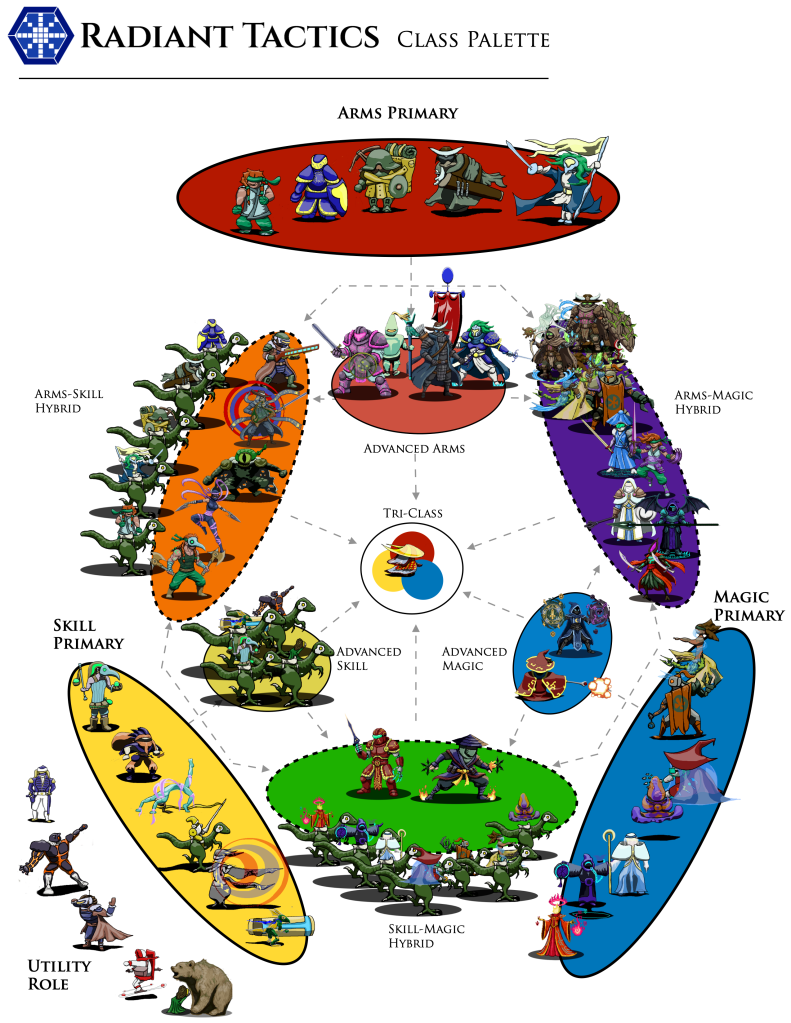
Imagine how you’d build your legend! Explore our comprehensive Class FAQ and accompanying Class Palette to see how Radiant Tactics debundles the traditional RPG archetype into a flexible, context-driven toolkit for every game mode. Your class is just the starting point, who you become is up to you.
1. What is a class in Radiant Tactics — identity, toolkit, or playstyle?
All three. And Radiant refuses to separate them.
A class in Radiant is shorthand for what your character is genuinely good at. To be called an “Acrobat” or a “Templar” means you have demonstrated a specific mastery in the world. That’s your class.
Class in one layer of playstyle. Species shapes your innate physical strengths. Equipment and spells defines your moveset. A trollgre fighter absorbs punishment. A centaur fighter controls space. Same class. Completely different play.
Class is also one layer of character’s identity. Your class derives from what you’re good at, but capability doesn’t wholly define you. Your beliefs, values, temperament, faction background? All can combine to author nuanced souls. species shapes how you move and survive. Your equipment defines your moveset.
And unlike some systems, you’re not locked in. Multiclassing is default design. Your character might be a scout–smith–templar, and all three are true at once.Your character might be a scout-smith-templar, and all three say something true about who they are. There are nine different ways to compose what another game might just call a “shaman.” If you’ve ever looked at another system’s version of a character archetype and thought that’s not quite right — Radiant is built for that feeling.
2. Do my classes work the same across different game modes — CCG, tactics, RPG?
Yes. And the more modes you play, the better you’ll know your character.
A warrior played in CCG mode has the same abilities as a warrior in RPG, 4x, or Fire Emblem-style tactical play. What changes is context, not character. Your scout’s Navigate ability is invaluable when exploring unfamiliar terrain and irrelevant in direct combat. Your smith’s crafting happens between adventures, not during them. Neither of those facts diminishes your character, rather, they reveal different facets of who they are.
Take a character you’ve only played in dungeon-crawl sessions into a traversal experience and discover that they’re surprisingly resilient in the wilderness. Take a character you’ve built around combat into a social intrigue scenario and discover exactly what they’re not good at. Radiant treats different modes as lenses, not resets. Each one shows you something new about a character you thought you already knew.
3. Will I have to rebuild my character when we switch modes?
No. The same acrobat adventuring through a dungeon one playnight might lead a 4x army another. Your character cards works across all modes.
What changes is how the system balances the funs of challenge and authorship:
Challenge and co-op play. Modes recommend a power level or BP point range that keeps things genuinely challenging. If your character is a demigod entering a low-level crawl, you can choose to bring a different character or work with the group to “tweak the challenge” of the module to fit. If your character is well above that range, you might choose to bring a different character that night — or the group can adjust the module’s difficulty together. Radiant surfaces that tradeoff clearly, so your group’s making the choice consciously, not stumbling into an imbalanced session.
Competitive play. You don’t rebuild for competitive modes. You pay your character’s BP point cost to field them as a Hero. Your authorial investment carries over; the format creates fair conditions around it.
Narrative and story play. You don’t need a new sheet, but you might need a new story. Switching modes is a prompt to author a “bridge” story—how did your character end up in this place, at this time, on this side of the conflict?
Radiant strives to keep your creative investment intact and lets context do the balancing.
4. Can my character’s class evolve over time — and what triggers that?
Yes. And what triggers it depends on the kind of story you’re part of.
In long-term narrative play, class evolution means your character has genuinely grown. The triggers feel earned: practicing a skill in high-stakes situations, discovering new theory, spending time around others of the same class who do things differently. A were character who wants to become a spell-hacker might need to earn the trust of a Fleet city-ship before they can access the academy. Progression structures make class changes feel more like major story beats, less like goals to grind for. The world of Phoibos doesn’t hand out mastery; your character has to pursue it, and the path of pursuit becomes part of who they are.
In adventure modules, class progression is tied more to pacing and power levels — class boosts mark earned rewards and keep challenges meaningful. For players running long-term story characters through shorter modules, these can be treated as short-term boosts with built-in narrative flexibility: a god granting a champion temporary power, reclaimed technology found and lost again, a character excelling briefly to something they’ll fully master later.
Radiant also supports different recipes for long-arc campaigns, including both same-group campaigns and org/guild-focused decentralized campaigns that one player can author across any session, with any group. Each recipe comes with recommended class progression styles that fit its pacing.
5. Are classes diegetic — real concepts in the world, or just player abstractions?
Real concepts in the world. When your character earns a new class in Phoibos, it means something not just in your stat sheet, but the world itself.
Classes in Phoibos are shorthand for what a person is genuinely good at. An acrobat is what you call someone who’s good enough at acrobatics that the label sticks. A templar is someone who’s mastered both vow magic and martial combat. The class is a social recognition of real skill.
What classes aren’t is offices. Phoibos is full of organizations, ruling powers, greater entities, and their worshippers — and the roles they grant, like Knight of Nox, can sound a lot like classes. But they aren’t. An office requires more than mastery: Does the god or ruler trust this character? Do they share the organization’s values? Does their magical ideology align with the faction’s politics? Phoibos isn’t perfectly meritocratic. A character can have every class qualification for an office and still be denied it. That gap between what your character deserves and what the world grants them is one of the richest places for your stories to live.
6. Can two characters share a class but feel completely different?
Yes! Completely. Shared class is a starting point, not a destiny.
Consider the fighter. A trollgre fighter is naturally tougher than most species: slow movement, hard to kill, built to absorb punishment and keep coming. A centaur fighter covers ground fast and uses movement to pick optimal engagements. Same class. Radically different combat identity.
Equipment pushes this further. A fighter wielding a greathammer builds around strong crowd control. A fighter with dual axes goes for limb damage and sustained pressure. Armor choices determine whether you’re a low-initiative defensive juggernaut or a quick glass cannon who powers special attacks with extra focus. Class and equipment choices combine to create different movesets entirely, not merely different scaling damage. (Think what Darksouls accomplished with its weapon design.)
Spell schools adds another axis entirely. Two clerics of different greater powers have access to fundamentally different toolkits. One supports through portals and map movement; another through haste and slow effects. Same class name. Different strategic identities.
And beyond mechanics, characters of the same class can hold completely different values, temperaments, magical ideologies, and factional upbringings. A Hierophant cleric and an Underdeep cleric share a class and almost nothing else. The class tells you what they’re good at, which is an important but incomplete part of who they are.
7. How does Radiant avoid solved metas or dominant builds?
This one deserves an honest answer, because solved metas create different problems in co-op versus competitive play.
In co-op, an overpowered build erodes three things at once: the fun of teamwork (an overpowered character needs little help), the fun of character expression (they’re as good at tricky stuff as a character built for it), and the fun of build exploration (once you’ve found optimal, there’s less reason to look further). Radiant’s first response is social — the power level recommendations exist precisely to make this visible. When someone brings a character well above the module’s range, the group can see it and decide together how to adjust. But Radiant is committed to letting you play your characters across all experiences, which means if someone insists on playing something that ruins others’ fun, the game system won’t stop them. That’s a playgroup conversation, not a design override.
The deeper structural answer is that Radiant’s context-dependency makes true optimization genuinely difficult. A team that dominates every combat encounter might succumb to dysentery in a traversal-focused experience. The team that breaks co-op balance in dungeon mode may be surprised by what a 4x or Fire Emblem-scale challenge does to them. Swapping modes is a real meta-reset.
In competitive play, solved metas kill the joy of discovery — new team compositions, unexpected builds, fresh matchups. Radiant’s PvP arenas address this through rotating, world-fitting build restrictions. Each arena literally takes place in a different part of Phoibos, where certain classes, equipment, and combinations shift in and out of availability. The setting does the balancing work, and it never feels arbitrary, because it’s always grounded in where you are in the world.
8. Can I create my own classes, and how does that work?
Yes! And there are three levels of how deep you want to go.
Create through combining. The first level of class creation is simply taking unexpected combinations seriously and making them work. Many of Radiant’s most interesting characters are built this way. With over 40 base class options and, when playing with high caps, over 5 classes per character, that’s 760k+ combinations to explore off the bat.
Create through offices. Earlier we talked about offices in Phoibos — the roles granted by organizations, rulers, and greater powers. With orgs and offices, you can build something that functions very much like classes do in other RPGs: spells, special equipment, and training that unlocks as your character advances through an organization’s ranks. In your narrative campaign, you can invent your own orgs with their own offices and progression. We also support supplements featuring canonical orgs with their own office structures. (Think prestige classes from early D&D, or base ‘fighter’ from even early getting castle and henchmen, but grounded in world of Phoibos.)
Create from scratch. We want groups to author their own stories through gameplay, and that includes inventing or riffing on existing masteries for your own group or others. We won’t be able to balance around fully custom classes — home-brew classes work for playgroups that adopt them, but our adventures and standard PvP formats won’t default to them. What we do plan to offer: disclosure of the BP modeling formulas we use to point complete unit + class + equipment combinations, so you can point your own creations on similar assumptions. The tools of the system, open to you.
Radiant is designed to be played with, and that includes the class system.
9. What makes a Radiant class feel different from classes in other games?
We’re big fans of D&D, Fire Emblem, and Warhammer 40k. Each one does something with classes that we try to learn from.
Compared to D&D
D&D’s classes are excellent at playstyle fantasy. That’s real design craft. But each class is a twenty-level monolith — a bundled package of attack scaling, equipment proficiencies, spell access, and abilities that you take or leave. Multi-classing is possible but limited; most characters manage two, rarely three. And if you don’t like D&D’s take on sorcerers, you don’t have many alternatives to playing one their way.
Radiant debundles that package. A class has three levels — Novice, Advanced, Master — and you compose your character from multiple classes rather than choosing one primary identity. There are nine different ways to build what D&D would call a shaman. Multi-classing isn’t a special case; it’s the norm.
D&D classes also used to have a richer relationship with the game world (Druid Circles, thieves’ guilds, followers) that’s been mostly lost over time. In Radiant, that relationship is central. Classes connect to offices, organizations, and the societies of Phoibos. And because all characters are built from the same class standards, any NPC, army, or faction force can be built from the same system you use for your protagonist — without the form-filling overhead of twenty levels.
Compared to Fire Emblem
Fire Emblem’s classes are masterful at tactical readability. When you see a unit on the field, you know its strengths, its weaknesses, and its matchups. The class system creates a puzzle where multiple pieces are needed and multiple solutions exist. That’s excellent design.
Radiant’s classes are more compositional, which means battlefield readability requires more work. We’re addressing this directly through battle role icons — visual indicators that communicate a unit’s trade-offs at a glance, because seeing a centaur warrior on the field doesn’t automatically tell you what they’re capable of.
Where Radiant’s approach pays off is in unit differentiation. Fire Emblem’s classes can feel flat within a role — one warrior is often hard to distinguish from another outside of weapon and stat shifts. In Radiant, a centaur warrior and a faye warrior share a class name and play completely differently: different movement ranges, different defensive profiles, different optimal engagements.
Both systems use weapons to shift how classes play, but differently. Fire Emblem’s weapon triangle leans on hard counters. Radiant’s weapons shift battle role more broadly and carry a wider range of effects beyond pure damage — which opens more angles for a character with the same class to feel genuinely distinct.
Compared to Warhammer 40k
40k doesn’t call it a class system, but its hero-building — spending points to compose an HQ character with equipment choices and special abilities — functions like one. And it does something many RPGs don’t: it makes your hero feel like a product of their organization. A Space Wolf HQ feels built from the Chapter’s distinctive culture, technologies, and hierarchies. That setting-rootedness is powerful and inspiring.
Radiant’s classes can’t achieve that on their own, but they’re designed to be supplemented. With BP build constraints and setting-specific organization restrictions, you can create a similar feeling — a character who feels drafted from, say House Hanor’s ranks, equipped with Hanor’s geistbone technologies, and who might repeat (or rebel!) Hanor’s ideologies and values.
40k also lets you author not just your protagonist but your supporting cast — that fantasy of adding your own chapter, complete with squads, typical force compositions, preferred equipment, to 40k’s vast universe. Radiant is built for this too. You can use the class system to design unit types in your own org, building something like your own codex force from the ground up. Unlike 40k’s pointing assumptions (which treat the same weapon as equal value across very different defensive brackets), Radiant’s BP system accounts for the likely rounds a weapon will actually be used. (It opens space for high defence, low offence builds more, forces that play for objectives over KOs, though makes a quick BP calculator harder to build.) We try to keep that complexity under the hood and give you codex-like experiences for wargaming modes.
 RADIANT TACTICS