
We’re deep into development mode right now, and wanted to use this Friday’s blog to connect dots between what we’ve released so far and where we are going.
Radiant Tactics lets you play and author RPG narratives at different subject scales:
Individual. Everyone plays a single character, with personal story arch more prominent. (Dungeons & Dragons and Pathfinder are examples of RPGs at this scale.)
Team. The story focuses more on a team, a roster of characters. Gameplay focuses more on each’s strengths & weaknesses, and composing the right team for the right situation. (Fire Emblem, Bloodbowl, and Pokemon are examples of RPGs at this scale.)
Organization. The story is more about an organization and its goals. Gameplay supports multiple squads deployed on maps and lots of units, some with personal arcs and some generic. (Some 40k factions, like Space Marine chapters, fit this scale. X-com is another example.)
Currently, we have designed core gameplay systems, such as combat, that scale so that any character you author can play across all experiences. More or less, the same combat ruleset is all you need to learn to play any scale of gameplay. (Find these free rules plus demos in our digital downloads section.)
What development is focusing on now includes:
Setting. Making the World of Phoibos a distinct place to author adventures in. Creating resources to easily imagine what narrative conflicts play out in Phoibos, the different major actors motivations and likely actions, and to create characters that feel like part of the world.
Non-Combat Gameplay. Support different approaches to resolving narrative questions through actual gameplay: surviving long wilderness trecks, persuading different groups, maneuvering and manipulating rooms by jumping, hacking, pushing, etc, and espionage gameplay. Likewise, crafting and economic mechanics that offer options for your story’s core experience.
Cookbook for RPG Storytelling. An RPG system that lets you freely switch between subject scales and genres of gameplay opens up new approaches to composing RPGs. We want to make it easy to cook up good stories that are authored through gameplay.
A big development question involves alternative workloads. Can we break up the workload many systems ask of GM/DMs —exposition, scenario design, umpire, group coordinator, world/opposition roleplayer, campaign design —so that GM can be more an opt in choice, more free to focus on creative parts that GMs enjoy most?
We’d like RPG storytelling to become more like home cooking. We’re working on general guides, recipes for campaigns, plot arcs, and individual battle, puzzle, and other encounters, that let your gaming group more flexibly choose what scale & experience it wants next, and how the work of authorship gets split up.
Friday’s WiP Diagram Previews
The World of Phoibos is a sci-fantasy setting. We chose to make it so for two reasons:
Cool Aesthetic. We’re inspired by and like the mixed ‘magic and technology’ looks of games like: Shining Force, Phantasy Star, Endless Legends, and Warhammer.
Interesting Major Question. Is a possible future where ‘magic’ is discovered even conceivable? Under what conditions would we say that the world has magic?
What’s unique about playing in Phoibos is its take on this major question. In Phoibos, there are two major perspectives on nature of magic:
A. Magic is just not yet understood science. There will be a causal explanation for any observed magical phenomena.
B. Magical phenomena is evidence that stuffs held non-rational — rocks, water, the forest biome — actually can act for reasons, posses motivations, goals, fears that can be appealed to. Magic is the action of a world that’s person-like.
On Phoibos, the question isn’t merely theoretical. When one faction believes another has, by acting contrary to water’s wishes, wronged water itself, this can put them in conflict with another faction that denies water person like traits.
The setting itself attempts to leave underdetermined which perspective is right, which has the most support of observation, and which can explain away best the objections of the other. Characters you author can pick a side, including many ‘in-between’ outlooks on magic’s nature and personal obligations to entities in the world.
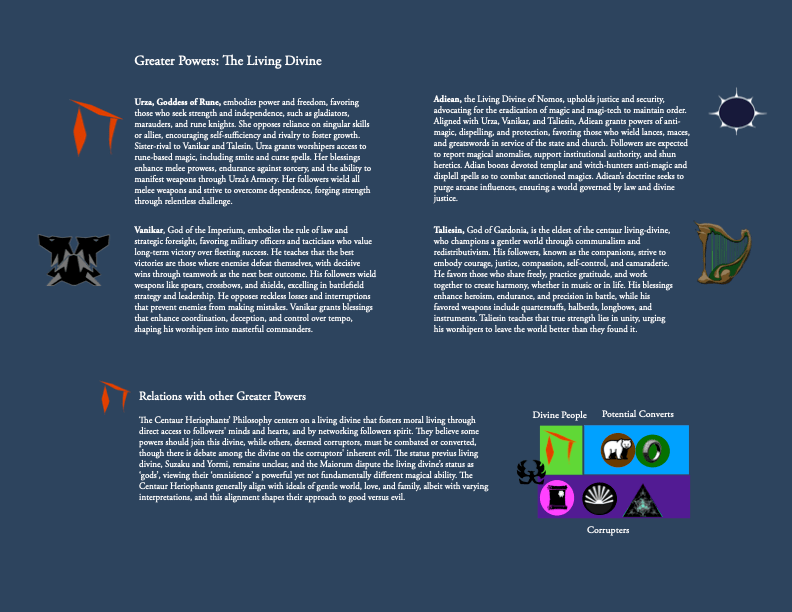
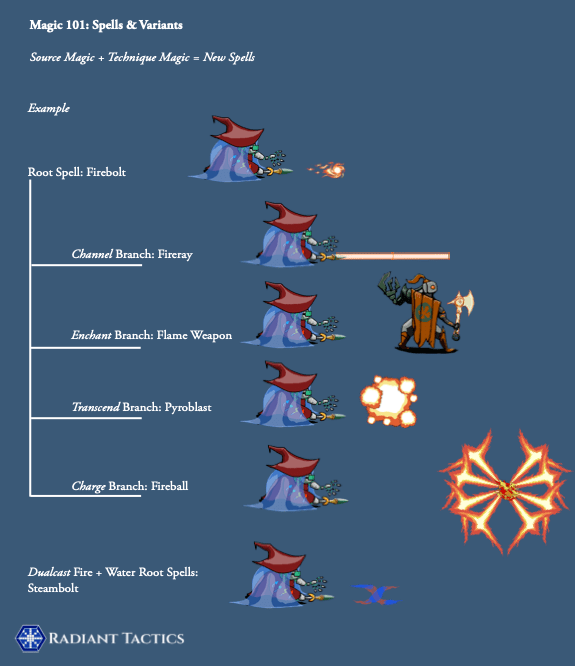
Here are some WiP diagrams that start to fill out the picture for what Phoibos’ magic is like, both in setting and in gameplay:
Happy Friday!
Thoughts?
What for you is interesting about magic and sci-fantasy settings? What conflicts and questions would you like to see exploreable through RPG play? Send all feedback to DreamingFoxLLC@gmail.com.
Support for Radiant Tactics is provided by gamers like you. Support Radiant on Patreon.
 RADIANT TACTICS