The World of Phoibos should be a major reason why you play Radiant Tactics. From Phoibos’ themes, its questions explored, stories possible, or the feeling of being there, we aspire to make the setting a place you will want to experience.
Battletech, Pokemon, Warhammer 40k: it’s the creative worlds of each that support a variety of media, card games, RPGs, tabletop, books, cartoons. We want to earn your time by making Phoibos likewise compelling
So, why then Phoibos? What’s interesting about Radiant Tactic’s universe, as opposed to its game systems?
We’ll start answering that question today, with two blog posts.
- The first post, this world building Q&A, starts outlining a broad stroke answer, looking at the inspirations, themes, and design behind Phoibos’ setting.
- The second post introduces the Necrotic Fay. This first ‘Faction Focus’ entry kicks off a series of previews of the concrete lore and concept art for Phoibos’ major factions.
We hope these blogs will have you excited about what’s to come! If you like our work, please share our content, or consider supporting Radiant Tactics on Patreon.
Phoibos’ World Building in Broad Strokes
We’re kicking off some world building Q&A! Have a question about Phoibos? Write to us to let us know what you want to hear more about!
Q. What other Setting is Phoibos Like?
A. Hyper-Light Drifter, Phantasy Star, Shining Force, Crystalis, Endless Legend, and Metroid: Phoibos draws inspiration from each. Phoibos is a hybrid ‘Sci-Fantasy,’ setting, where technology and magics developed in parallel. It’s set long after an inter-galactic conflict and resultant disaster that makes salient certain questions:
- Why did the ancient civilizations fall? Did their fall reveal something inherently flawed with government, economy, or society?
- What will the new generation do with a broken environment?
- How can the catastrophic mistakes of the past be avoided anew?
- Who is ultimately responsible for the disaster? Is justice possible?
We hope such questions resonate with fans of both science fiction and fantasy!
Q. Phoibos is Fantasy How?
A. Magic vs Technology, Magic vs Science. The idea that there is some fundamental conflict between the two has been a major theme among many works of fantasy. The world of Phoibos offers its own thesis on what is fundamentally at stake.
In Phoibos, anyone can observe the event of a bolt of flame conjured from seemingly nothing. Yet, what explains it?
That question is a mystery, an antinomy. That question is a major source of conflict among the various peoples of Phoibos, whom disagree on its answer.
Some of Phoibos’ people hold that there is only an epistemic difference between the explanations of the bolt of flame and, say, a crossbow bolt fired. In one case, natural theories around elastic potential energy account for the crossbow bolt’s motion, while the natural theories that will explain the bolt of flame just need some more work.
Others on Phoibos disagree. Crossbow bolt firings are explained by causes. Yet, firebolt firings are explained by reasons. The bolt of flame? It was fire itself choosing to respond to sorcerer’s needs; it was what fire or some fire god saw reason to do. Magical phenomena like firebolts are evidence of a reason-responsive world, a world possible to relate to like a person. Relate to, with all the space for obligations, promises, mistrust, betrayal and other conflicts possible in relations between persons.
Who is right? Phoibos has no all-knowing narrator to arbitrate. The fundamental issues of magic and technology are presented only from the interested perspectives of Phoibos’ peoples. It’s up to the settings’ fans to judge which arguments are most persuasive.
Q. What are the Main Factions? What are their themes and design philosophy?
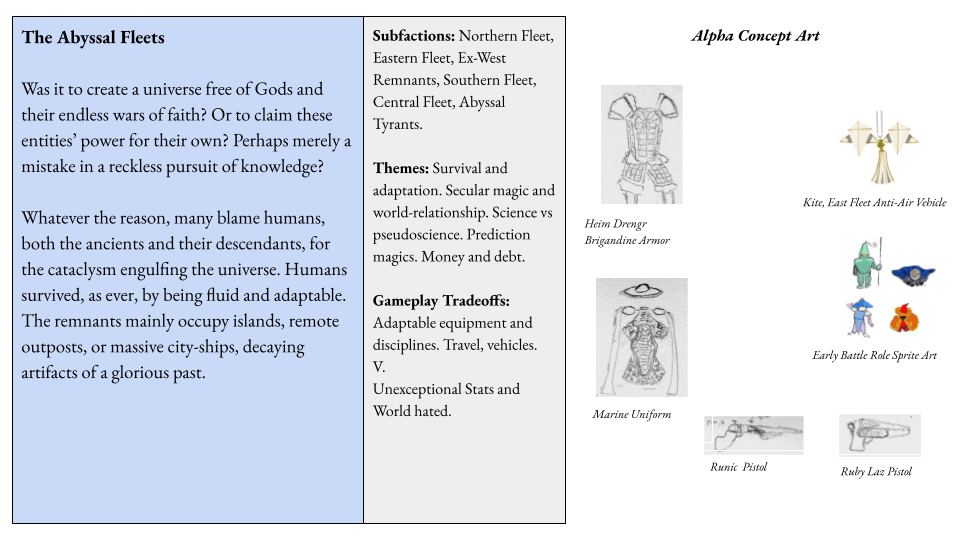
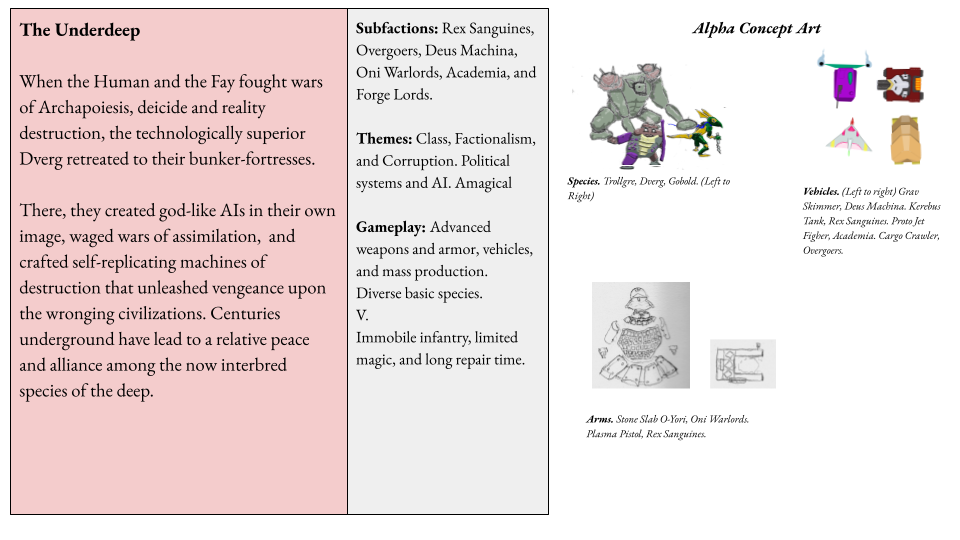
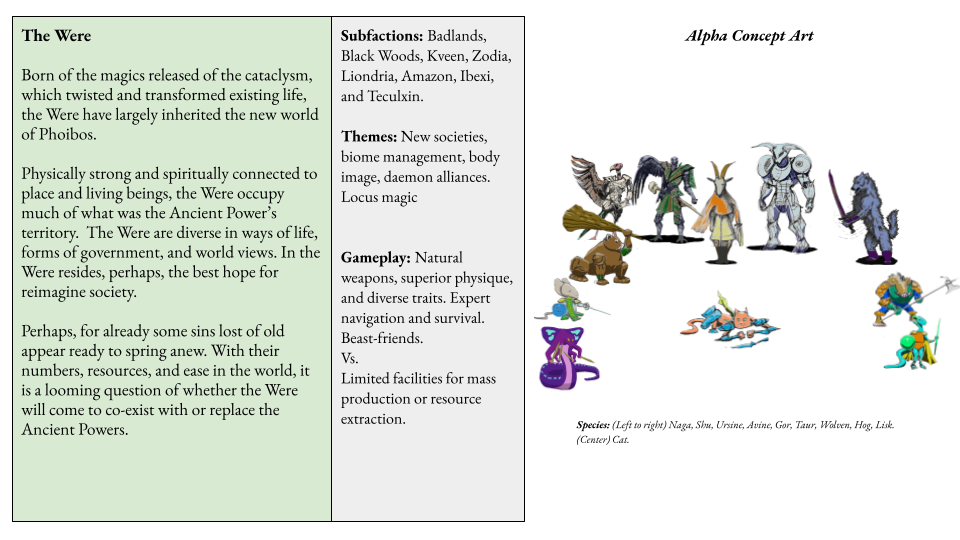
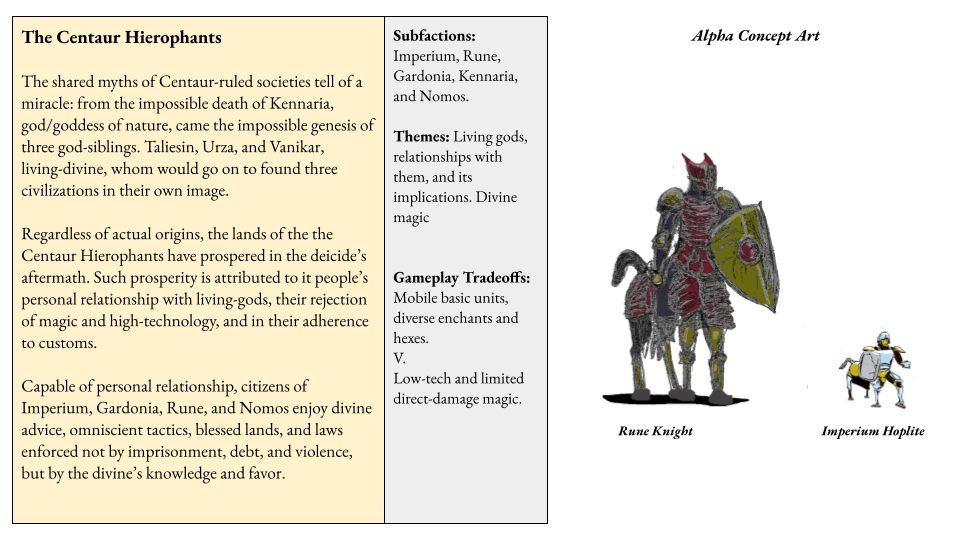
A. Magic the Gathering excelled in design of its opposing forces. Black, White, Red, Green, Blue: each plays as one would expect from how the set of cards look, their visual and design themes coherent and supported by game mechanics.
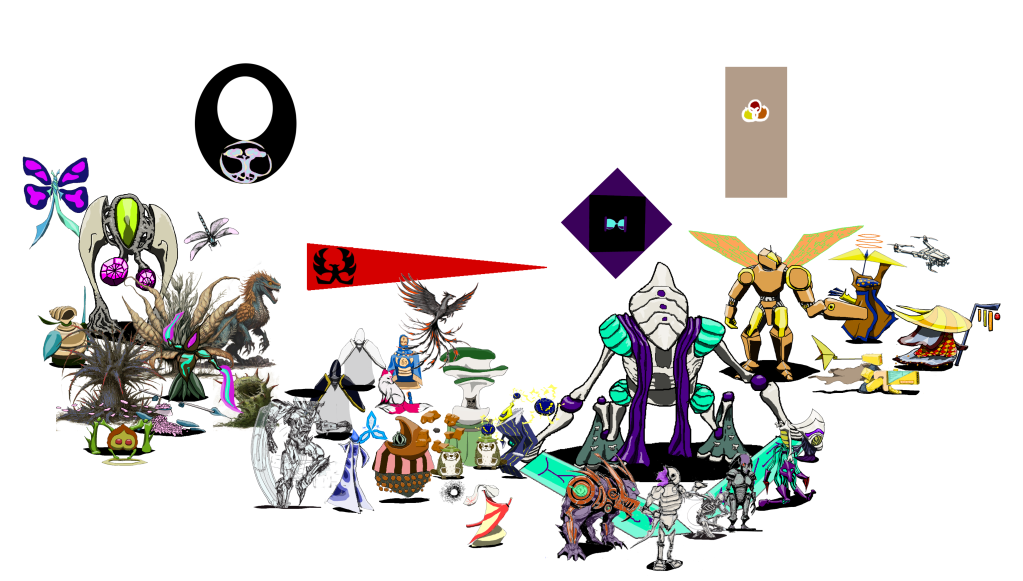
Phoibos’ faction design aspires to match the bar set by Magic the Gathering. Purple, Green, Yellow, Red, Blue: Phoibos five major factions divide its varied peoples by their shared history or common origin.
Each color has a theme, a shared challenge or issue facing those people. Yet, within a color, different peoples come to different conclusions — some fleeing mortality and others accepting, some embracing AI and integrating it fully to society, while others stand against thinking machines.
Each color has a gameplay palette that supports the theme, access or restrictions to technology and magics, strength or weakness of units, or through size and origination of its forces. Some within a major faction play like a hybrid deck, combining the tradeoffs of two colors.
Q. Faction Focus? Who are the Fay?
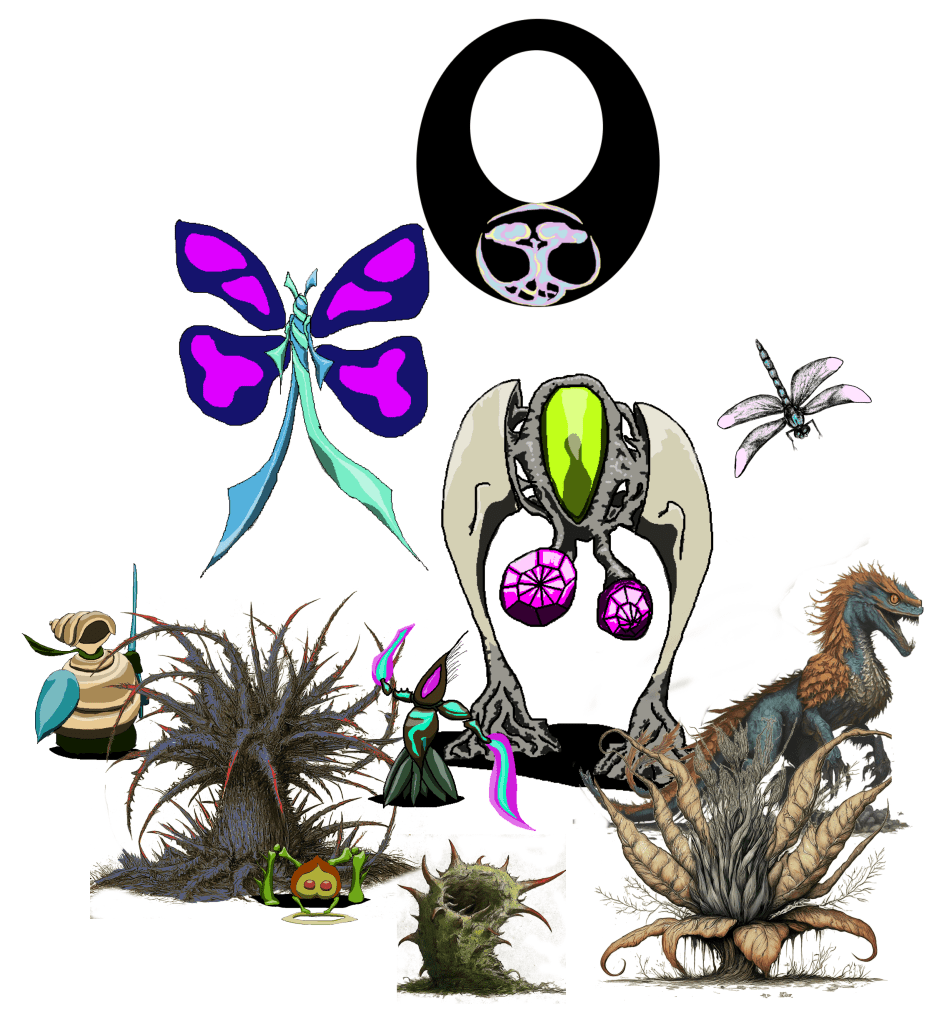
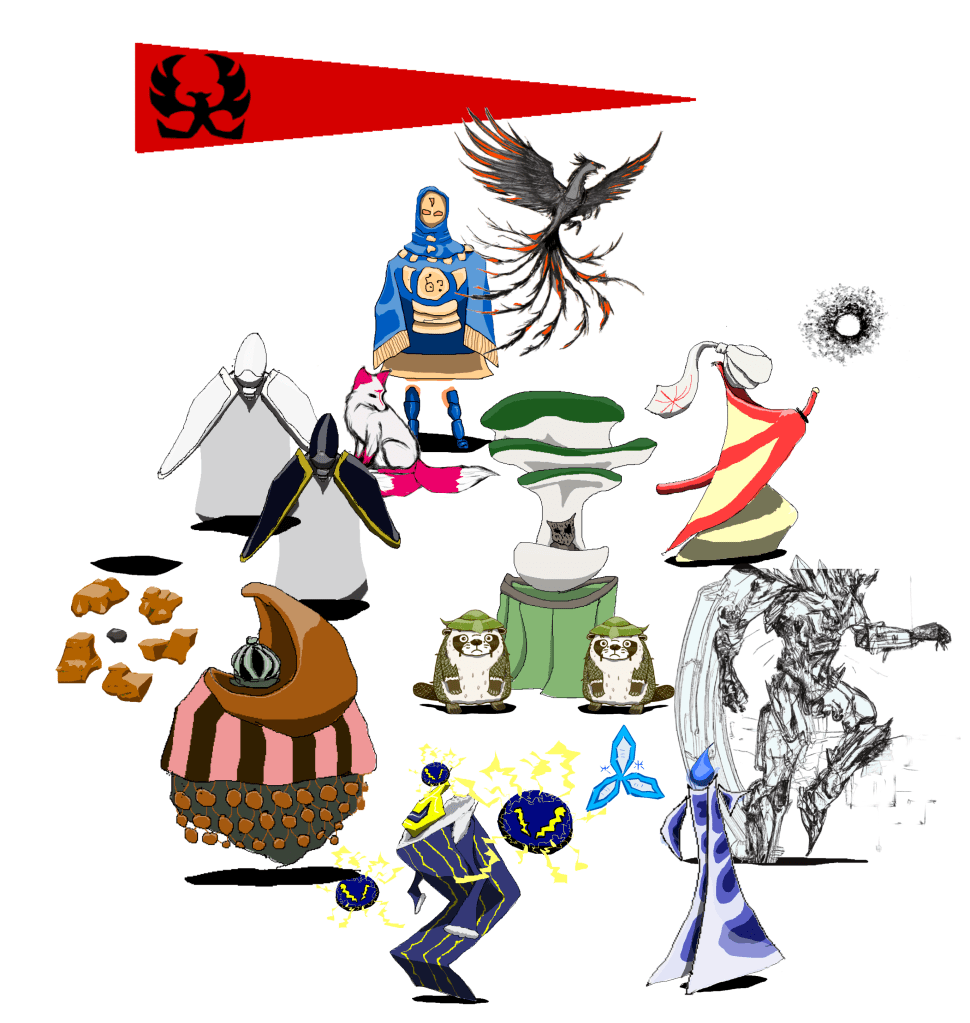
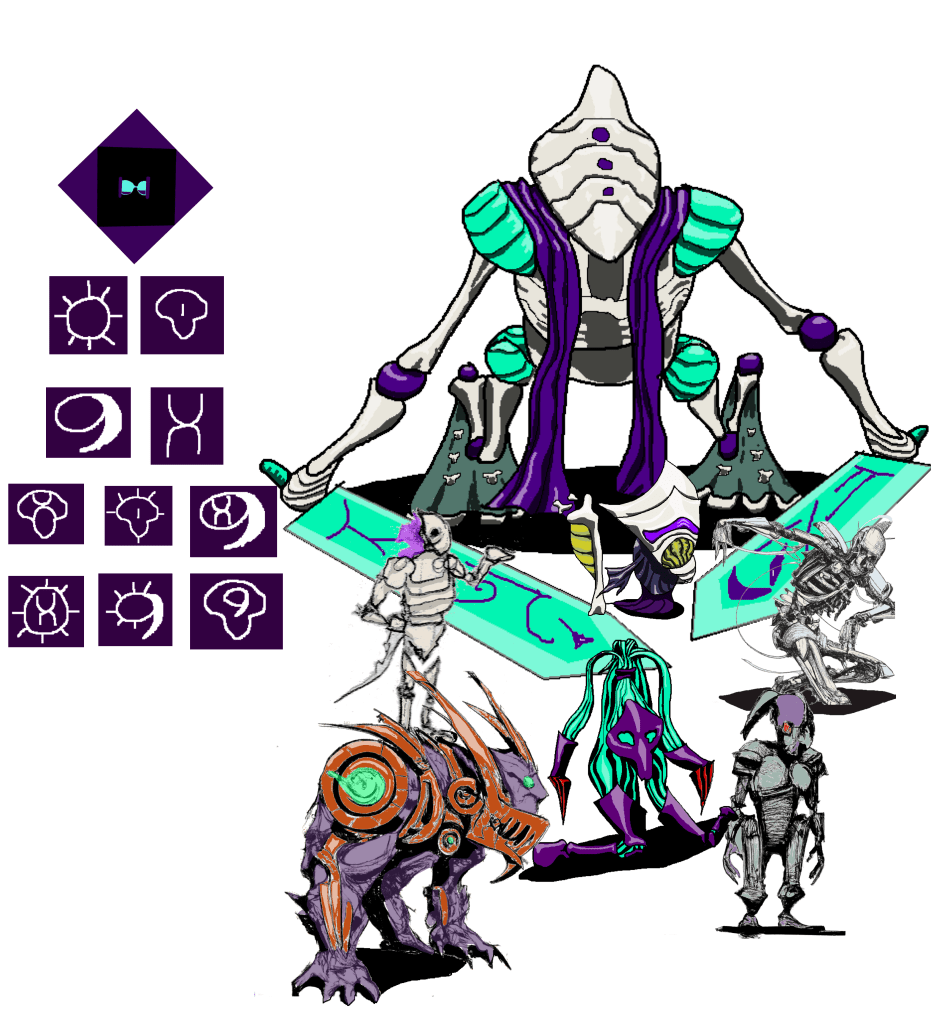
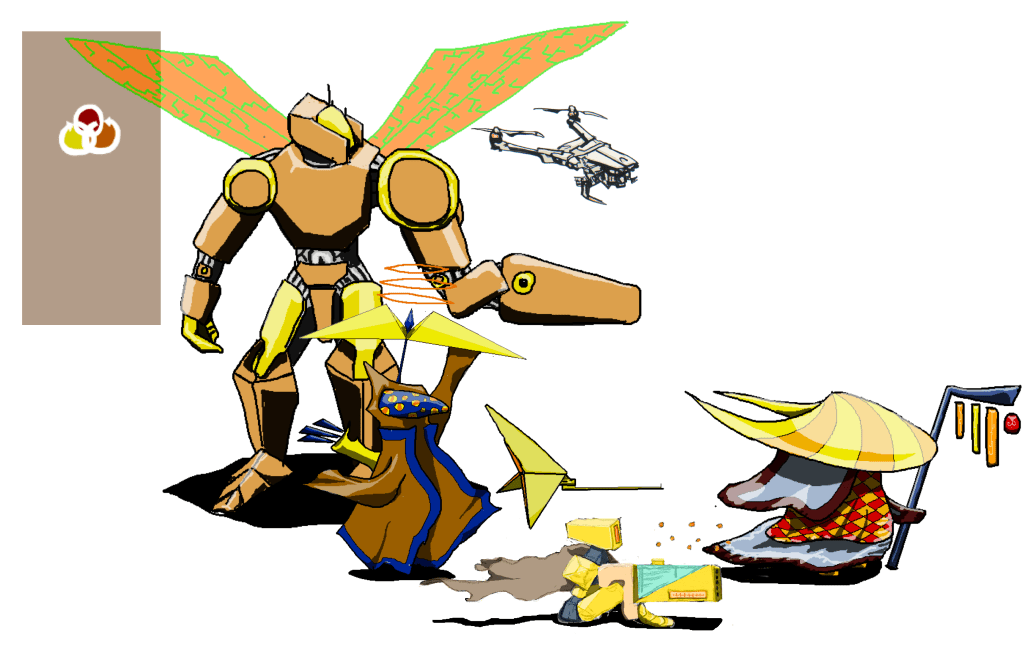
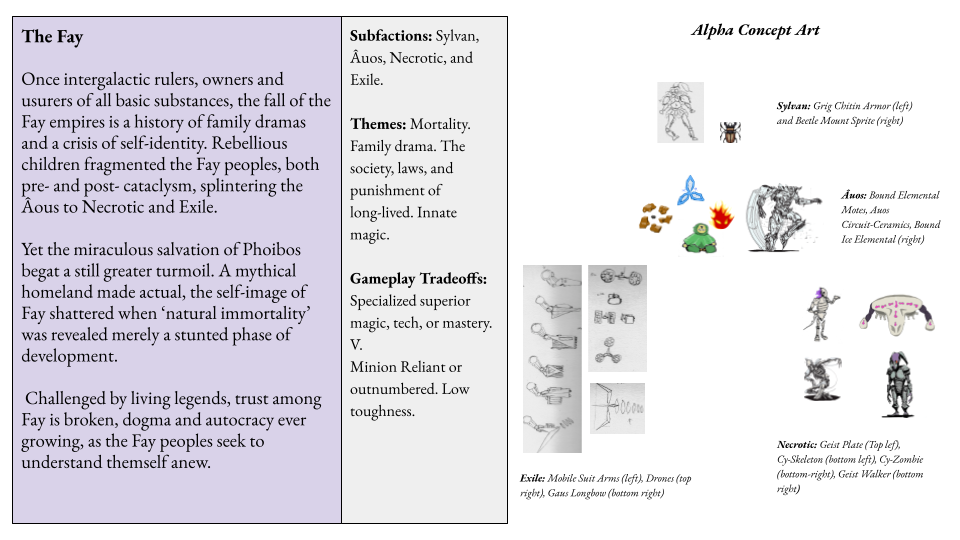
A. Once intergalactic rulers, owners and usurers of all basic substances, the fall of the Fay empires is a history of family dramas and a crisis of self-identity. Rebellious children fragmented the Fay peoples, both pre- and post- cataclysm, splintering the Âous to Necrotic and Exile.
Yet, miraculous salvation begat a still greater turmoil. A mythical homeland made actual, the self-image of Fay shattered when ‘natural immortality’ was revealed by the returned Sylvan to be merely a stunted phase of development.
Challenged by living legends, trust among Fay is broken, dogma and autocracy ever growing, as the Fay peoples seek to understand themself anew.
Q. …And the Necrotic Fay?
A. The Necrotic fay followed Lunasa, who rejected the Auos’ hegemonic society, ideology on magic, and claims to elemental rulership. Lunasa and her peers founded a society unified in pursuit of true immortality.
Find out more about what happened in our Faction Focus preview of the Necrotic fay!
The End
And that’s it for today! If you liked this post, be sure to check out the Faction Focus. You might also support Radiant through sharing content, signing up for content updates, or materially on Patreon. Happy gaming!
 RADIANT TACTICS